皂液
創作者:李映頎 Yin-Chi Lee
減輕白人負擔的第一步,是透過教導潔淨的美德。— 1899年 Pears 肥皂廣告語。
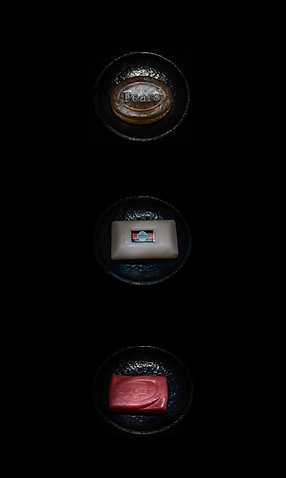
《皂液》以三塊肥皂為核心隱喻與物質載體,揭示帝國如何以「潔淨」之名,對殖民地身體進行日常化的規訓與監視。作品援引 Anne McClintock 在《帝國皮革》中提出的「商品種族主義」,探討帝國權力如何透過 Pears、Lifebuoy 等肥皂品牌,將台灣、馬來亞與菲律賓在二戰前後的 勞動身體納入一套可被觀看與分類的治理結構,並透過最私密的身體儀式:梳洗與潔淨將種族階序內化為日常實踐,延續至當代全球供應鏈之中。 在此脈絡下,鏡中勞動者的動作對應橡膠、馬尼拉麻與樟腦的採集步驟,提問在帝國的系統裡,肉身是否也是被物化為可榨取的原料。勞動者模仿殖民者的「潔淨標準」,在體系中換取「合格帝國公民」的歸屬感。
做為一件多重空間結構的沉浸式互動裝置。觀眾將穿越一組以「洗浴」為核心隱喻的展場動線,逐步進入一套關於身體、潔淨與權力的感知機制。此空間將觀眾的身體直接置入「潔淨/污穢」的分類邏輯中,使觀看轉化為一種自我辨識與錯位,並要求觀眾從國家與殖民地建構的潔
淨/污穢視角中,打撈被過去與現在的亞洲勞動身體。
聚焦於太平洋島鏈上三段彼此交織的「經濟奇蹟」,以及其背後被遮蔽的勞動剝削歷史:臺灣樟腦、馬來亞橡膠與菲律賓馬尼拉麻。這些產業構成二戰前後全球經濟的重要支柱,而其勞動者則是帝國機器運作的基石。臺灣樟腦曾壟斷全球近九成產量,勞工在高溫蒸餾中提煉出的結晶,成為好萊塢賽璐珞底片的原料,也轉化為帝國軍事擴張所需的無煙火藥以及西方的玩偶;其生產背後,亦伴隨勞動者的艱困處境,以及包括泰雅族等原住民族群土地被迫轉移與剝奪的歷史。馬來亞橡膠支撐了西方工業與消費體系,從現代化交通所依賴的輪胎,到塑造女性身體形象的彈性內衣(如 Playtex Cross Your Heart),皆源自熱帶叢林中被反覆割取的乳白汁液;而橡膠並非原生於馬來亞,其種子由南美洲(亞馬遜地區)被殖民體系轉移至英屬種植園,成為被重新配置以服務西方經濟的作物。菲律賓馬尼拉麻則因其高強度與耐鹽性,被編織為美國與大英帝國海軍艦隊的巨型纜繩,牽動全球軍事運輸與殖民航線;其原生植物在殖民體制中被轉化為帝國軍事與航運所依賴的戰略資源。
作者以作品審思作為流散台灣人的身體記憶。熬煮臺灣樟腦的身體於皇民化體制中被同化,其勞動成果既轉化為帝國的無煙火藥與賽璐珞底片,也將其自身推向南洋戰場,呈現出既是被殖民者、亦是帝國擴張工具的矛盾位置;馬來亞橡膠女工在凌晨的熱帶林中割取乳汁,其勞動支撐西方消費體系,卻同時在洗手台前被要求服膺於 Pears 所建構的女性潔淨與文明想像,形塑出合格的身體符號;而菲律賓馬尼拉麻勞動者,則在 Lifebuoy 所灌輸的「體臭」羞恥中,學習清潔自身,而此肥皂的原料來自他們親手榨取的椰子油。帝國成為一個自我循環的結構:將土地與身體的資源提煉為商品,再反向規訓其來源的身體。


WHITE BLOOD
ARTIST:李映頎 Yin-Chi Lee
“The first step in lifting the White Man’s burden is to teach the virtues of cleanliness” — Pears Soap advertisement slogan, 1899.
White Blood is a multimedia installation that interrogates how colonial power entered the body through the language of hygiene, civility, and purification. Structured around three bars of soap as both material object and conceptual metaphor, the work examines the ways imperial systems transformed cleansing into a disciplinary technology through
which colonised bodies were rendered visible, governable, and morally legible.
Drawing upon Anne McClintock’s notion of “commodity racism” through her writing around Imperial Leather, the installation traces how brands such as Imperial Leather, Pears and Lifebuoy embedded racial hierarchies within the intimate rituals of washing and grooming. Through everyday acts of bodily maintenance, the empire extended itself
into domestic space, where cleanliness became entangled with modernity, state disciplines, and the performance of contemporary civilisation. Within this framework, White Blood explores the bodies as sites through which imperial and colonial legacies are rehearsed, internalised, and reproduced.
The work situated itself across three interwoven “economic miracles” within the Pacific colonial network: Taiwanese camphor, Malayan rubber, and Philippine Manila hemp. These industries formed crucial infrastructures of the global economy before and after the Second World War, while the labouring bodies sustaining them remained largely
erased from dominant historical narratives.
Taiwanese camphor once supplied nearly ninety percent of the global market. Distilled through intense heat by labourers working in mountainous extraction sites, camphor crystals became the raw material for Hollywood celluloid film, smokeless gunpowder for imperial warfare, and Western celluloid dolls. Embedded within this history are the
displacements of Indigenous communities, including Atayal peoples, whose lands were appropriated under colonial expansion. Malayan rubber, extracted through repetitive incisions into tropical trees before dawn, sustained Western industrial modernity: from automobile tires that enabled global mobility to elastic undergarments such as the Playtex Cross Your Heart bra, which disciplined and reshaped the modern feminine body. Yet rubber itself was never native to Malaya; its seeds were transferred from the Amazon through colonial botanical networks and reorganised into plantation economies serving imperial capitalism. Philippine Manila hemp, valued for its tensile strength and
resistance to seawater, became indispensable to American and British naval infrastructures, woven into the massive ropes that enabled military transport, colonial shipping routes, and maritime expansion. Across all three contexts, land, vegetation, and bodies were reorganized into strategic resources for the empire.
Within White Blood, the labouring body corresponds to the extraction processes of camphor, rubber, and hemp, asking whether the human body itself had become another raw material within colonial systems of production. In mimicking colonial standards of cleanliness, labourers were compelled to perform eligibility for inclusion within imperial modernity, inhabiting a paradoxical condition in which assimilation became both survival mechanism and mode of erasure. The work further reflects upon the artist’s own embodied memory as a diasporic Taiwanese subject situated within broader Pan-Asian histories of colonial entanglement.
Under Japanese imperial assimilation policies, Taiwanese Hakka and Hokkien bodies extracting camphor were simultaneously positioned as both the colonial and colonised subjects and instruments of imperial expansion. Their labour produced the smokeless gunpowder and celluloid infrastructures of the empire, while their bodies were also
mobilised into Southeast Asian battlefields. Malayan rubber workers, particularly women labouring in predawn plantations, sustained Western consumer economies while being subjected to imported ideals of feminine hygiene and civility promoted through colonial advertising. Philippine labourers producing Manila hemp encountered Lifebuoy’s rhetoric of bodily shame and contamination, despite the soap itself being manufactured through coconut oil extracted by their own hands. The Empire thus operated as a self-perpetuating circuit: extracting resources from colonised lands and bodies, transforming them into commodities, and returning them as instruments of discipline
directed back upon their origins.
As an immersive spatial environment, White Blood guides audiences through a choreographed architecture of bathing, cleansing, and surveillance. Mirrors, projected silhouettes, industrial materials, and fragmented archival imagery produce a sensory terrain in which viewers themselves become implicated within classificatory systems of
purity and contamination. Spectatorship shifts from passive observation toward embodied confrontation, requiring audiences to navigate the unstable boundaries between intimacy, complicity, memory, and violence.
The installation also interrogates the ethics of representation itself. Responding to Carole Boyce-Davies’ critique of naming and Judith Butler’s articulation of subject formation through power, White Blood asks: when contemporary art invokes the bodies of those historically rendered “other”, does it risk reproducing the very imperial gaze it seeks to critique? Rather than offering resolution, the work inhabits this tension, positioning performance and installation as spaces where fragmented histories, unresolved inheritances, and embodied contradictions may coexist.
At its core, White Blood examines how colonial structures persist beyond formal empire through the invisible logics of contemporary global supply chains, where Asian labouring bodies continue to be abstracted, sanitised, and detached from historical memory. By placing Taiwan alongside Malaya and the Philippines, the work unsettles Western-centered postcolonial narratives and instead foregrounds the more unstable and layered power relations operating within Asia itself. Through transnational artistic practice, White Blood attempts to reconnect macro-histories of empire with intimate bodily experience, transforming the body from an object of extraction and spectatorship into a site capable of historical reflection and resistance.
White Blood mihi to the mana whenua of Central Auckland, Ngāti Whātua Ōrākei. May White Blood stands as an acknowledgment of the endurance, solidarity, and continued resistance of communities confronting the violences of both historical and ongoing colonial structures.
Creator: Yin-Chi Lee
Collaborators:
Kyung Ho Min (Korea)
Darryl Chin (Singaporean Hakka)
Jefferson Chen (NZ/Chinese)
Performers:
Anna Lee (NZ/Chinese)
Darryl Chin (Singaporean Hakka)
Jefferson Chen (NZ/Chinese)
Jacob Reynolds (NZ/Pakeha)
Nathan Gacusan (Philippines)
Lee Vui-Tong (Malaysian Hakka)
Special Thanks:
Chin Choy Woon (Malaysian Hakka)
John Ross (NZ/Pakeha)
Talia Pua (NZ/Malaysian Hokkien)
Louise Jiang (NZ/Teow Chinese)
Red Leap Theatre (NZ)


